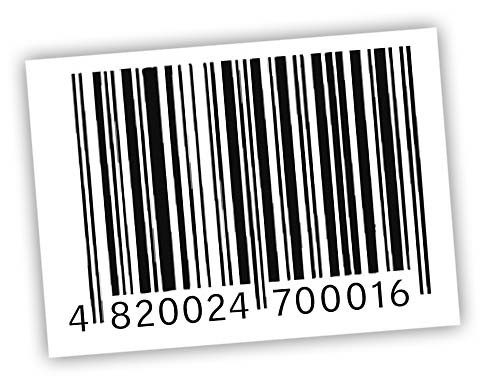
A barcode (full name - barcode) is a computer-generated graphic image (lines or stripes) of a specific sequence of numbers (sometimes letters). The image is developed based on numbers, which are called the digital equivalent of the barcode.
Barcode (full name - barcode, English barcode) - is a computer-generated graphic image (lines or stripes) of a certain sequence of numbers (sometimes letters). The image is developed based on numbers, which are called the digital equivalent of the barcode.
A sequence of absolutely any characters (numbers) can be represented in the form of line art. From characters understandable to humans, the computer prepares an image that can be read by an automatic device. Programs used to obtain a barcode image based on specified characters are called barcode generators. Thanks to this technology, when it becomes necessary to enter data into a computer, there is no need to type numbers on the keyboard manually. To do this, simply hold a special reading device - a scanner connected to the computer - up to the barcode image, and the program will simply reproduce the original digital equivalent (number) from the sequence of bars. The data will be instantly entered into the computer without the use of additional input devices (keyboard).
Barcodes are mainly used by goods and distributors. They are applied to packaging, thereby indicating a digital link to the manufacturer and the name of the product. Barcodes allow for automated entry of product data into a computer. It should be noted that in some countries, barcodes are applied to products solely to add value to the packaging and attract consumer attention.
The application and reading of barcodes should be regulated by a special organization, similar to how car license plates are assigned. In the interests of article numbering, the European Article Numbering Association EANA was organized in 1977. Based on the American UPC (Universal Product Code), it developed the structure of a universal code suitable for all countries of the world. Subsequently, the Association changed from European to international. It is thanks to this organization that the most common type of barcode EAN (the most widely used 13-digit code EAN-13).
Structureof the EAN-13 barcode
The EAN13 Bar Code is continuous, has a fixed length and high recording density, allowing 13 digits from 0 to 9 to be displayed. The code designation can be expressed by eight (EAN8) or thirteen (EAN13) digits, and in the second case, only twelve digits are actually encoded, and the 13th is calculated using a specific formula. The EAN bar code symbols consist of two bars and two spaces. The bar image of all 12 (8) digits makes up the EAN code symbol. The symbols on the edges (the extended strokes - the signs of the beginning and end of the symbol) define its boundaries; the symbol is divided into two parts by a separating mark (the extended strokes in the center of the symbol).
Characteristicsof the positions of the full and abbreviated codes in the EAN system
It is possible that two symbols are allocated for the country of manufacture code and five for the company code. It should also be remembered that the barcode does not contain information on the classification of the goods, i.e. and the country code (the first 2-3 digits), and the company code (the next 4-5 digits), and the product code (the next five digits) are unique (the only and unrepeatable) for this product and are at the same time the product number in the database where it is registered. Therefore, the first 2-3 digits are the country code or, in other words, the country number in the international database.
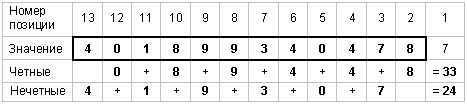
Let's take, for example, the digital code 4||018993||404787||. The first two digits (40), if read from left to right, indicate the country of manufacture (or seller) of the product ("country flag"), in this case, Germany. The next five (18993) indicate the manufacturer. Another five (40478) are the name of the product. And finally, the last digit (7) is a check digit, used to check the correctness of the reading of the previous digits of the code by the scanning system. You can determine the code check digit yourself using the following mathematical operations.
Calculating the EAN-13 code check digit
1. Add up the digits inevenpositions, theninoddpositions: 2. Now we add the result of adding the digits in even positions, multiplied by three and the result of adding the digits in odd positions: (33*3) + 24 = 123. 3. The check digit is the difference between the final sum (123) and the nearest largest multiple of ten (in this case, 130): 130 - 123 = 7. 4. The resulting last seven corresponds to the check digit.
Excel formulafor calculating the check digit of the EAN-13 barcode
[cell] - the cell containing the 12-digit barcode. In the Russian version of Excel, instead of the MOD and MID functions, use MOD and MID, respectively:






 RSS Feed